
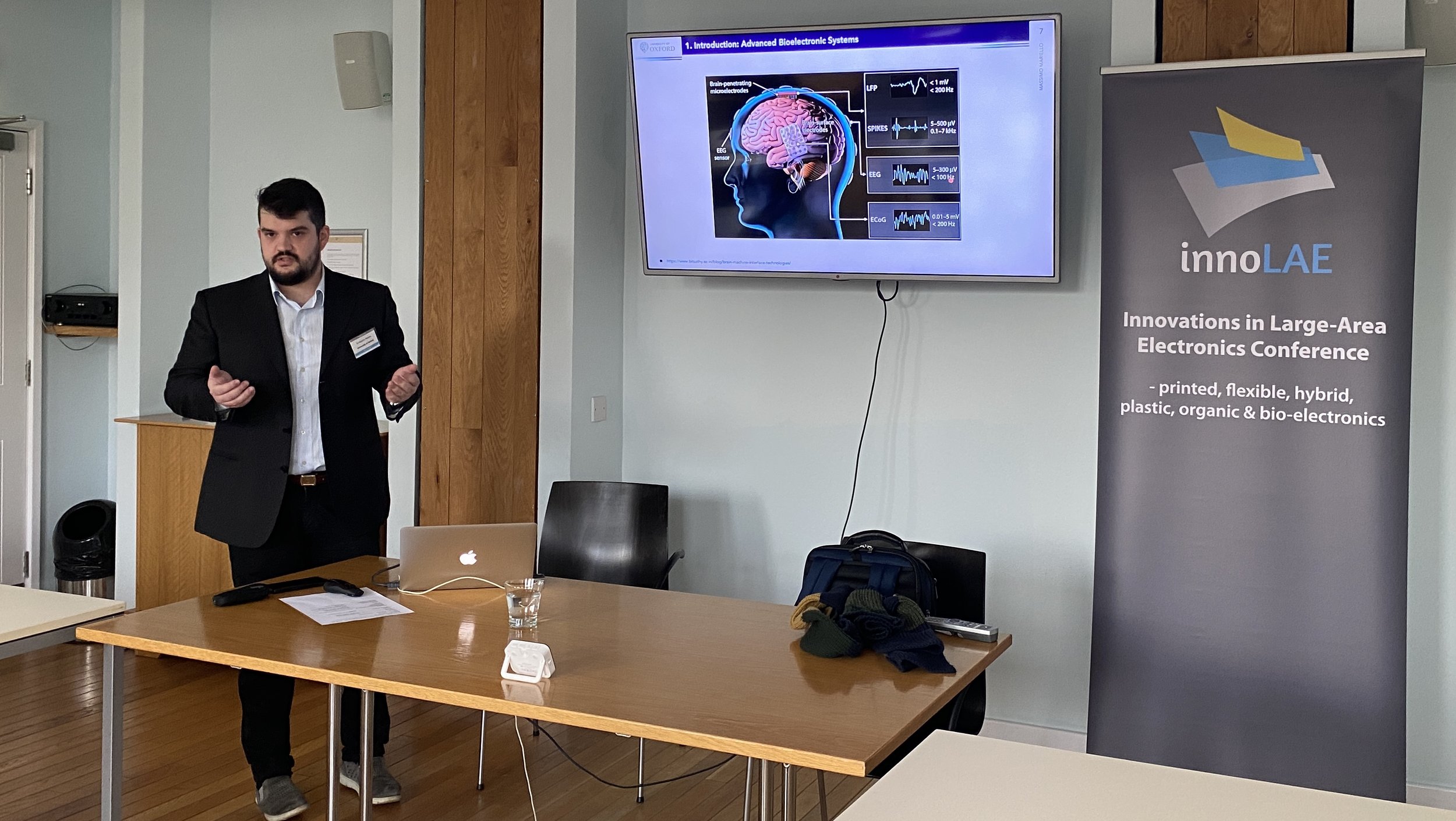
Short Course - Energy Harvesting and Wireless Technologies for Flexible Bioelectronics
Monday 15 February 2027
Cripps Court Conference Centre, Magdalene College, Cambridge, UK
COURSE FOCUS
This course will discuss energy harvesting, wireless power transfer and wireless communication technologies for flexible and wearable/implantable bioelectronics, with emphasis on their underlying physical mechanisms, functional materials and integration into soft biomedical systems.
Next-generation bioelectronics increasingly require operation without bulky batteries, rigid electronics or transcutaneous wiring. Energy can instead be generated locally from mechanical, thermal, biochemical or electromagnetic sources, or supplied wirelessly through inductive, capacitive, ultrasonic or radiofrequency links. The course will examine the materials and transduction mechanisms enabling these approaches, including piezoelectric, triboelectric, thermoelectric, photovoltaic and biofuel-cell technologies, and their compatibility with flexible and stretchable substrates.
Wireless powering and communication strategies will be discussed alongside practical constraints including power density, transmission distance, tissue absorption, antenna/coil miniaturisation and mechanical integration. Examples of commercial and translational systems will illustrate how these principles are implemented in real wearable sensors, wireless electrophysiology platforms and implantable devices.
The final section will address a frequently underestimated requirement for autonomous bioelectronics: long-term reliability. Failure mechanisms, accelerated ageing, mechanical fatigue, biofluid ingress, packaging and thin-film encapsulation strategies will be discussed, connecting energy autonomy with stable long-term operation.
COURSE OUTLINE
Monday 15 February 2027
13:00 – 13:30 Registration
13:30 Course begins
Introduction: towards autonomous flexible bioelectronics
From wired to wireless and battery-free bioelectronics
Wearable, epidermal and implantable systems
Power density, energy density and duty cycle
Energy requirements of:
Biosensors
Electrophysiology and neural recording
Electrical stimulation
Drug-delivery systems
Wireless telemetry
Matching energy source, storage and device consumption
Energy-harvesting mechanisms and materials
Piezoelectric energy harvesting
Triboelectric energy harvesting
Thermoelectric energy harvesting
Other biointegrated energy sources
Energy storage and power management
Wireless powering of flexible and implantable systems
Near-field versus far-field approaches
Inductive coupling
Resonance and coupling coefficient
Flexible coils and miniaturisation
Capacitive coupling
RF and electromagnetic powering
Flexible antennas
NFC/RFID concepts
Ultrasonic wireless power transfer
Piezoelectric receivers
Acoustic propagation through tissue
Optical powering
Tissue absorption, heating and safety
Choosing the appropriate wireless-power mechanism
Wireless communication and telemetry
NFC and RFID
Bluetooth Low Energy
Backscatter communication
Ultrasonic communication
Data rate versus power consumption
Antennas and interconnects under bending/stretching
Closed-loop sensing–communication–actuation
Choosing the appropriate wireless-communication protocol
From mechanisms to real systems: industrial demonstrations and case studies
Stability and reliability of autonomous bioelectronics
Why energy autonomy does not guarantee long-term autonomy
Principal failure mechanisms:
Reliability under bending, stretching and cyclic loading
Accelerated ageing in physiological environments
Stability of wireless links and power-transfer efficiency
Battery and energy-storage degradation
Packaging and encapsulation
· Rigid versus flexible packaging
· Silicone/elastomer encapsulation
· Thin-film encapsulations
· Hermeticity and water-vapour transmission
· Electrical/electrochemical methods for detecting encapsulation failure
· Designing simultaneously for power, flexibility, biointegration and lifetime
Conclusions: designing autonomous bioelectronic systems
Selecting the appropriate harvesting/powering mechanism
Materials, transduction, power management, wireless link, application
Trade-offs between miniaturisation, power, communication distance and lifetime
Future directions: battery-free, self-powered and closed-loop bioelectronics
17:00 Course ends
COURSE LEADER
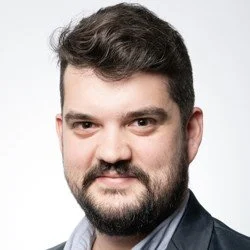
Dr Eng. Massimo Mariello, Senior Postdoctoral Research Associate
University of Oxford, UK
Dr Massimo Mariello holds a Bachelor of Science (Industrial Engineering, October 2015), a Master of Science (October 2017) and PhD (May 2021) in Materials Engineering and Nanotechnology at the University of Salento and Italian Institute of Technology (Italy). He worked on flexible nanogenerators based on piezoelectric and triboelectric materials for mechanical energy harvesting and biosensing. As postdoctoral scientist at the École Polytechnique Fédérale de Lausanne (EPFL, Switzerland, 2021-2023), he worked on implantable neuroprostheses and thin-film encapsulations. He developed a universal method for assessing quantitatively and accurately the reliability of barrier coatings and bioelectronic devices, based on the biodegradation of Magnesium thin-film permeability sensors. His research focuses on micro-devices, soft (bio)materials, neural interfaces, translational medicine. He is currently senior postdoctoral research associate at the Institute of Biomedical Engineering (IBME) (Department of Engineering Science, University of Oxford). He is investigating laser-micropatterned advanced bioelectronics and neural interfaces for stimulation and drug delivery. He is member of the Italian Professional Body of Engineers, Standard-Bearer of Labour of the Italian Republic and Enterprise and Innovation Fellow of the Mathematical, Physical and Life Sciences Division of the University of Oxford.